

Thank you for Subscribing to Auto Business Outlook Weekly Brief


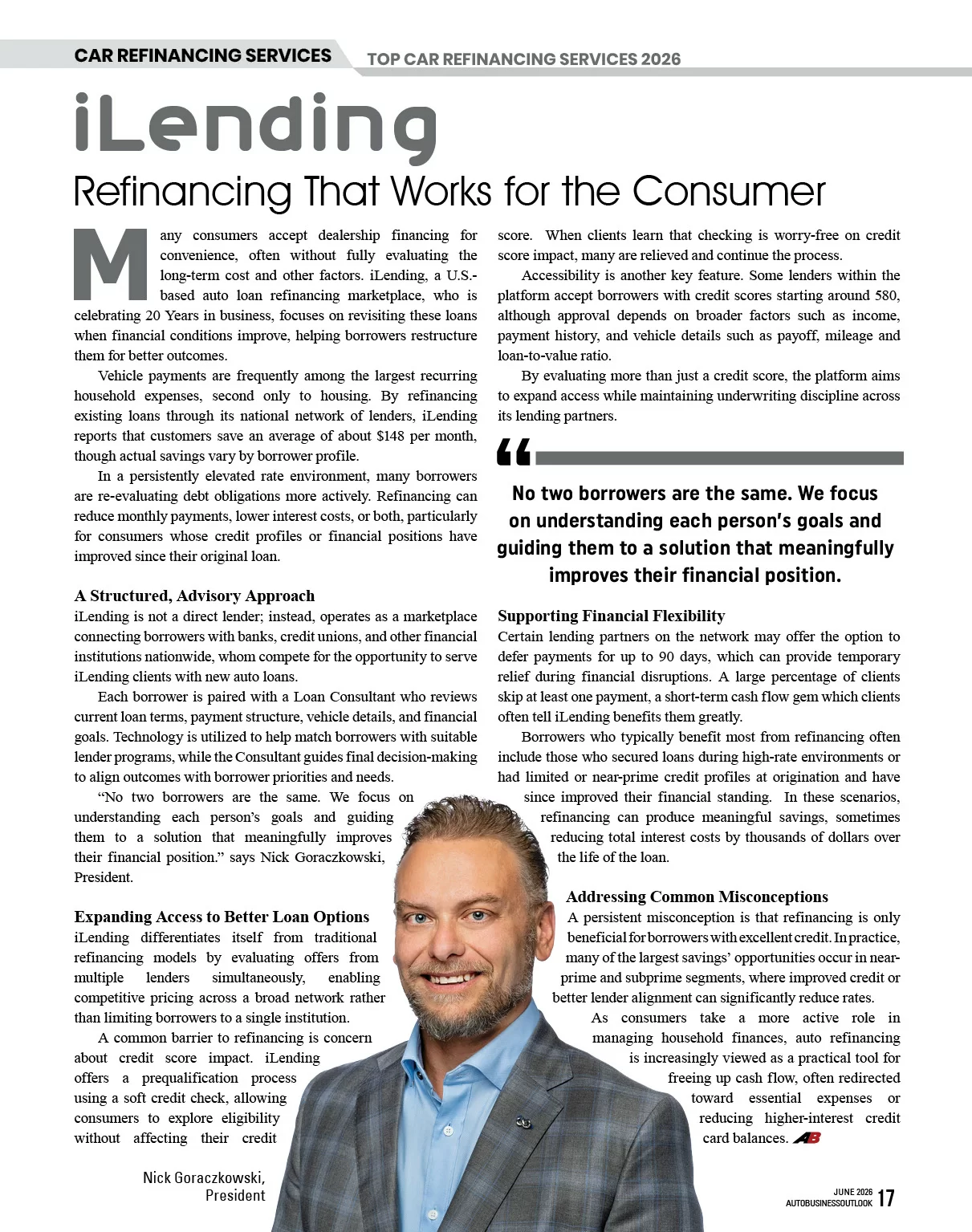
 Nick Goraczkowski, President
Vehicle payments are frequently among the largest recurring household expenses, second only to housing. By refinancing existing loans through its national network of lenders, iLending reports that customers save an average of about $148 per month, though actual savings vary by borrower profile.
In a persistently elevated rate environment, many borrowers are re-evaluating debt obligations more actively. Refinancing can reduce monthly payments, lower interest costs, or both, particularly for consumers whose credit profiles or financial positions have improved since their original loan.
A Structured, Advisory Approach
iLending is not a direct lender; instead, operates as a marketplace connecting borrowers with banks, credit unions, and other financial institutions nationwide, whom compete for the opportunity to serve iLending clients with new auto loans.
Each borrower is paired with a Loan Consultant who reviews current loan terms, payment structure, vehicle details, and financial goals. Technology is utilized to help match borrowers with suitable lender programs, while the Consultant guides final decision-making to align outcomes with borrower priorities and needs.
“No two borrowers are the same. We focus on understanding each person’s goals and guiding them to a solution that meaningfully improves their financial position.” says Nick Goraczkowski, President.
No two borrowers are the same. We focus on understanding each person’s goals and guiding them to a solution that meaningfully improves their financial position.
iLending differentiates itself from traditional refinancing models by evaluating offers from multiple lenders simultaneously, enabling competitive pricing across a broad network rather than limiting borrowers to a single institution.
A common barrier to refinancing is concern about credit score impact. iLending offers a prequalification process using a soft credit check, allowing consumers to explore eligibility without affecting their credit score. When clients learn that checking is worry-free on credit score impact, many are relieved and continue the process.
Accessibility is another key feature. Some lenders within the platform accept borrowers with credit scores starting around 580, although approval depends on broader factors such as income, payment history, and vehicle details such as payoff, mileage and loan-to-value ratio.
By evaluating more than just a credit score, the platform aims to expand access while maintaining underwriting discipline across its lending partners.
Supporting Financial Flexibility
Certain lending partners on the network may offer the option to defer payments for up to 90 days, which can provide temporary relief during financial disruptions. A large percentage of clients skip at least one payment, a short-term cash flow gem which clients often tell iLending benefits them greatly.
Borrowers who typically benefit most from refinancing often include those who secured loans during high-rate environments or had limited or near-prime credit profiles at origination and have since improved their financial standing. In these scenarios, refinancing can produce meaningful savings, sometimes reducing total interest costs by thousands of dollars over the life of the loan.
Addressing Common Misconceptions
A persistent misconception is that refinancing is only beneficial for borrowers with excellent credit. In practice, many of the largest savings’ opportunities occur in near-prime and subprime segments, where improved credit or better lender alignment can significantly reduce rates.
As consumers take a more active role in managing household finances, auto refinancing is increasingly viewed as a practical tool for freeing up cash flow, often redirected toward essential expenses or reducing higher-interest credit card balances.
Rethinking Auto Loan Economics through Refinancing Strategy
Rising vehicle costs and elevated interest rates have made auto loans one of the most sensitive pressure points in household balance sheets. For executives evaluating car refinancing services, the challenge is less about access to lenders and more about how effectively a solution reshapes the borrower’s financial trajectory. Many consumers enter loans through dealership financing, drawn by convenience rather than long-term cost efficiency. This often results in higher rates or rigid structures that fail to adapt as credit profiles improve or economic conditions shift. The result is a growing need for refinancing solutions that do more than present alternative rates, instead enabling structured decision-making that aligns with evolving financial circumstances.
A meaningful refinancing service distinguishes itself through breadth of access combined with interpretive guidance. A narrow relationship with a single bank limits borrowers to one set of underwriting assumptions, while a wider network introduces competitive tension and expands the range of viable outcomes. Yet access alone is insufficient. Borrowers frequently lack the expertise to interpret trade-offs between rate, term and payment flexibility. Solutions that embed advisory support into the process tend to deliver stronger financial outcomes because they translate options into tailored strategies rather than static offers. This shift from transactional matching to guided structuring reflects a broader change in consumer expectations, where financial decisions are increasingly approached with the same discipline applied to business cash flow management.
Another defining element lies in how the refinancing journey addresses psychological barriers. Many borrowers hesitate to explore alternatives due to concerns about credit impact or uncertainty around eligibility. Services that allow early-stage evaluation without immediate credit consequences create a more informed decision environment. This approach reframes refinancing from a risk-laden action into a diagnostic exercise, encouraging participation from borrowers who might otherwise avoid engagement. Greater transparency at the outset tends to surface opportunities that remain hidden when fear governs behavior, particularly among near-prime or improving credit segments that often benefit most from refinancing.
Loan structuring depth also plays a central role in determining long-term value. Effective solutions evaluate the full borrower profile, including income stability, vehicle equity and repayment goals, rather than relying solely on credit scores. This multidimensional view enables alignment between borrower intent and lender risk appetite, producing outcomes that balance inclusivity with responsible lending. It also supports flexibility in addressing real-world financial disruptions, where temporary relief mechanisms or adjusted payment schedules can prevent longer-term distress. Refinancing, in this context, becomes less about rate reduction and more about reshaping financial resilience.
iLending exemplifies this evolved model by combining a large national network of credit unions and lenders with a structured advisory layer and supporting technology. It does not limit borrowers to a single institutional perspective, instead creating competitive options that are evaluated against individual financial goals. Each borrower is paired with a dedicated consultant who guides loan structuring decisions, ensuring that outcomes reflect more than headline rates. Its process allows consumers to explore qualification without immediate credit impact, reducing hesitation and enabling informed engagement. The platform’s ability to match diverse borrower profiles with appropriate lending partners, while considering factors beyond credit score alone, positions it as a strong choice for organizations prioritizing both financial improvement and borrower confidence.
...Read more
Car Refinancing Services Info
Q1
What Should Drivers Expect From Car Refinancing Services?
Car Refinancing Services help borrowers replace an existing auto loan with a new one that better aligns with their current financial situation. This can be helpful when the original loan no longer matches income, credit profile or current interest rate conditions. The aim is not just to secure a lower rate but also to adjust monthly payments, reshape the loan term or recover from a financing decision made under dealership pressure. Drivers should carefully review payoff amount, remaining term, vehicle value and total interest cost before moving forward, since extending the loan term may improve monthly affordability but increase total repayment over time.
Q2
How Does iLending Make Refinancing Easier to Compare?
iLending makes refinancing easier by letting borrowers fill out a quick online application and then speak with a loan consultant who walks them through their goals and available options. The initial check is designed not to impact credit score, and the platform connects users with more than 50 lenders so they can compare multiple offers instead of relying on a single bank quote. Its Car Refinancing Services are built to simplify decision making, with reported average savings of about $148 per month depending on the borrower and loan details.
Q3
When Can a Refinance Make the Most Sense?
Refinancing often makes sense when a borrower’s credit has improved, when market interest rates have dropped below the original loan rate or when existing payments are putting pressure on other financial obligations. Car Refinancing Services can also support changes such as adjusting loan terms or removing a co-signer when lender rules allow it. Every decision should be based on real numbers, including fees, remaining balance, new interest rate and how long the borrower expects to keep the vehicle.
Q4
Which Details Matter Before Choosing a New Loan?
Small differences in loan structure can significantly affect whether refinancing delivers real savings. Drivers comparing Car Refinancing Services should understand how the new APR is calculated, whether lower payments come from a reduced interest rate or simply a longer repayment period, and how factors like vehicle age, mileage or loan-to-value ratio may affect approval. A meaningful comparison should clearly show both monthly payment changes and total repayment cost instead of focusing only on the lowest monthly figure.
Q5
What Makes iLending Useful After a Borrower Chooses a Loan?
iLending also supports borrowers after they select a refinancing offer by helping with documentation, lender coordination and follow-up through the closing process. Its Car Refinancing Services extend beyond standard cars to include trucks, motorcycles, RVs, campers, boats, ATVs and other powersport vehicles. This reduces administrative friction so borrowers do not have to manage multiple lender communications or paperwork steps on their own after making a decision.
Q6
How Should Drivers Judge Service Quality?
Service quality in Car Refinancing Services becomes most visible after prequalification, when borrowers start reviewing real offers. Strong providers clearly explain eligibility requirements, how rates are determined and what loan terms actually mean while allowing time to compare without pressure. It is also important that limitations are communicated upfront, including credit approval conditions, vehicle eligibility and lender-specific rules. A good experience should leave the driver with a clear understanding of monthly payments, total repayment cost and the tradeoffs behind each refinancing option.
